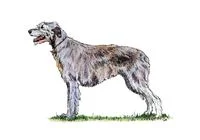
If you have ever run your hand across an Irish Wolfhound’s unmistakably rough coat, you may have wondered something every prospective owner eventually asks:
Do Irish Wolfhounds shed?
Yes, they do.
But that simple answer doesn’t tell the whole story.
Irish Wolfhounds aren’t typically associated with the dramatic clouds of loose fur people imagine when they think about heavily shedding dogs. Their coat is different: coarse, wiry and designed to protect a hound historically expected to work outdoors in demanding conditions.
Nevertheless, hair comes out.
You will find some on your clothes. Some will make its way onto the sofa. And, because an adult Irish Wolfhound is an enormous dog, even relatively moderate shedding can produce a surprising amount of loose hair.
The difference between a home covered in Wolfhound hair and one where shedding is barely an inconvenience often comes down to one thing:
good coat maintenance.
Here’s what owners need to know.
So, How Much Do Irish Wolfhounds Actually Shed?
Irish Wolfhounds are best thought of as regular shedders rather than non-shedding dogs.
They naturally lose old and damaged hair as their coat renews itself.
The amount varies from dog to dog.
One Wolfhound may leave relatively little hair around the house, while another may require noticeably more brushing to keep loose coat under control.
There is also something important prospective owners sometimes overlook:
An Irish Wolfhound has a lot of surface area.
This is one of the world’s tallest dog breeds.
So even when the rate of shedding isn’t extraordinary, there is simply a great deal of dog from which that hair can come.
That distinction matters.
An owner expecting a virtually shed-free breed is likely to be disappointed. An owner expecting manageable shedding from a giant, rough-coated hound will have much more realistic expectations.
What Does an Irish Wolfhound’s Coat Feel Like?
The coat is one of the features that gives the Irish Wolfhound its wonderfully rugged appearance.
Run your fingers through a correct adult coat and it should not feel silky, fluffy or excessively soft.
It is characteristically rough and hard, with particularly wiry hair around the eyes and underneath the jaw.
That shaggy facial hair is responsible for much of the unmistakable Wolfhound expression.
And this coat isn’t merely decorative.
The breed developed as a working hound. A tough outer coat offered practical protection from weather, vegetation and demanding outdoor conditions.
That history explains why attempting to turn an Irish Wolfhound’s coat into something perfectly smooth and manicured rather misses the point.
A Wolfhound should look like a Wolfhound.
Do Irish Wolfhounds Shed Throughout the Year?
Expect some degree of shedding throughout the year.
The exact amount can fluctuate.
Changes in daylight, temperature, living environment and the individual dog’s coat cycle can all influence how much loose hair you notice.
Dogs living predominantly indoors may also experience less sharply defined seasonal coat changes because household temperatures and artificial lighting are relatively consistent.
The practical lesson is simple:
Don’t wait for a particular month to start grooming your Wolfhound.
Make coat care part of your normal routine all year.
When you notice more dead hair coming away during grooming, increase the frequency temporarily.
Your dog’s coat will tell you more than the calendar.
What Does Irish Wolfhound Shedding Look Like in a Real Home?
This is where breed descriptions don’t always prepare first-time owners for reality.
You probably won’t wake up one morning to discover that your Wolfhound has deposited half its coat in the hallway.
Instead, shedding tends to announce itself quietly.
A few coarse hairs appear on the sofa.
Then you notice some caught in the carpet.
There’s a little more on the dog’s bed.
You stroke your Wolfhound and several hairs remain on your jumper.
None of this is unusual.
The problem develops when loose coat isn’t removed regularly.
Hair that could have been collected during a grooming session gradually distributes itself throughout the house instead.
For most owners, prevention is much easier than chasing Wolfhound hair around the home with a vacuum cleaner.
The Most Effective Way to Control Irish Wolfhound Shedding
There is no magic shampoo, supplement or grooming gadget that switches shedding off.
Nor should there be.
Shedding is a normal biological process.
Your objective isn’t to stop your Irish Wolfhound for sale from shedding.
It is to remove dead and loose hair efficiently while keeping the remaining coat and skin in good condition.
And for that, nothing replaces regular grooming.
How Often Should You Brush an Irish Wolfhound?
For an average companion Irish Wolfhound, a thorough weekly grooming session is a useful baseline.
The emphasis should be on thorough.
Running a brush across the back for two minutes isn’t the same as properly grooming a giant hound.
Work systematically.
Start at one end of the dog and make your way across the body, checking:
- neck and shoulders
- chest
- back and sides
- belly
- legs
- hindquarters
- tail
- beard and facial furnishings
You are looking for loose hair, dirt, debris and tangles, but grooming also gives you something equally valuable:
a chance to examine your dog.
With your hands moving across the entire body, you are much more likely to notice an unusual lump, small wound, irritated patch of skin or other change that might otherwise remain hidden beneath the coat.
Don’t Make This Common Grooming Mistake
One of the easiest mistakes is grooming only what you can see.
A quick brush over the outer surface may make the dog look tidier, but it can leave loose material deeper in the coat untouched.
Take your time.
Part the coat where necessary and make sure your grooming tools are actually reaching the areas that need attention.
Be particularly careful around sensitive skin.
More pressure does not mean better grooming.
If you are repeatedly scraping the skin to remove hair, something is wrong with either your technique or your choice of tool.
What Is Hand-Stripping — and Does an Irish Wolfhound Need It?
If you research Irish Wolfhound grooming for long enough, you will eventually encounter the term hand-stripping.
It sounds more alarming than it is.
Hand-stripping is a traditional grooming technique used with certain wire coats. Rather than cutting dead coat with clippers, mature dead hairs are carefully removed so that new coat can grow through while the characteristic wiry texture is maintained.
Irish Wolfhounds are among the breeds whose coats can benefit from this technique.
But there is an important qualification:
Hand-stripping is a skill.
A knowledgeable groomer understands which hairs are ready to come away and how to remove them without causing unnecessary discomfort.
If you have never done it before, don’t learn by aggressively pulling at your dog’s coat.
Ask an experienced Irish Wolfhound breeder, exhibitor or groomer to show you what a properly maintained coat should feel like and how dead hair is identified.
For the average family companion, sensible regular brushing remains the foundation of coat care.
Should You Shave an Irish Wolfhound to Stop Shedding?
No — shaving should not be treated as a shortcut for ordinary shedding.
It sounds logical:
Less hair on the dog must mean less hair on the sofa.
But a dog’s coat doesn’t work that way.
Clipping the hair short doesn’t stop the underlying growth and shedding cycle.
More importantly, the Irish Wolfhound’s rough coat is part of the breed’s natural protection and character.
For normal coat maintenance, concentrate on removing dead hair rather than simply removing the coat.
There are situations in which veterinary treatment, severe matting or another practical consideration may require clipping an area. Those are different circumstances and should be handled appropriately.
But routine shedding alone isn’t a good reason to shave a Wolfhound.
What Grooming Tools Do Irish Wolfhound Owners Need?
You don’t need a professional grooming salon in your spare room.
A small collection of well-chosen tools is far more useful than a drawer full of equipment you don’t know how to use.
Depending on your individual dog’s coat, useful equipment can include:
A good-quality brush
For routine removal of loose hair, surface debris and everyday coat maintenance.
A sturdy metal comb
Useful for checking that you have actually worked through the coat rather than merely smoothing the surface.
An appropriate rake or coat tool
Helpful where loose coat needs to be worked out carefully.
Specialist stripping equipment
Potentially useful for experienced owners maintaining a proper wire coat.
Nail-care equipment
Because grooming an Irish Wolfhound involves considerably more than brushing.
The best tool is not necessarily the most expensive one.
It is the tool appropriate for your dog’s coat, used correctly.
The Beard Deserves Special Attention
The magnificent Wolfhound beard has one unfortunate characteristic:
It catches things.
Water.
Food.
Mud.
Saliva.
And occasionally substances you’d rather not investigate too closely.
Check it regularly.
After meals, drinking and particularly messy walks, a quick wipe can prevent moisture and debris from sitting in the facial hair.
This isn’t primarily about making the dog look pristine.
It’s basic hygiene.
A clean beard is considerably more pleasant for both the Wolfhound and whichever unfortunate human receives the next enthusiastic face rub.
How Often Should You Bathe an Irish Wolfhound?
An Irish Wolfhound does not need to be constantly shampooed simply because it sheds.
Bathing should be done when necessary, rather than according to an obsessive schedule.
A muddy hound may need cleaning.
A dog that has rolled in something unspeakable definitely does.
But routine brushing can remove a surprising amount of dried dirt and debris without requiring a full bath.
When bathing is necessary:
- Use a shampoo formulated for dogs.
- Work it through the coat carefully.
- Rinse thoroughly.
- Make sure no shampoo residue remains.
- Dry the dog properly.
Remember the scale of the animal you’re dealing with.
Bathing a fully grown Irish Wolfhound is considerably closer to a project than bathing a Chihuahua.
Introducing bathing and grooming calmly during puppyhood will make life much easier later.
Do Irish Wolfhound Puppies Shed?
Yes — and their coat changes as they mature.
A puppy’s softer coat gradually gives way to the more characteristic adult coat.
That makes puppyhood the perfect time to establish grooming habits.
Not because a young puppy necessarily needs lengthy grooming sessions, but because you want a future giant dog to consider handling completely normal.
Teach your puppy to accept having its:
- feet handled
- nails examined
- ears checked
- mouth inspected
- beard touched
- legs brushed
- body combed
Keep sessions brief and positive.
A small puppy refusing to cooperate with a brush can be amusing.
A mature Irish Wolfhound deciding that grooming is optional is a rather different negotiation.
Are Irish Wolfhounds Hypoallergenic?
No.
Irish Wolfhounds should not be described as hypoallergenic.
This is particularly important for families researching the breed because they assume a rough or wiry coat automatically means fewer allergy problems.
Dog allergies are more complicated than visible shedding.
People can react to proteins associated with dander, saliva and other biological material, not simply the hairs they see around the house.
A dog that leaves less visible hair behind is therefore not automatically safe for someone with dog allergies.
If allergies are a serious concern, spend meaningful time around adult Irish Wolfhounds before making a commitment.
Don’t base a potentially decade-long decision on the word “hypoallergenic” appearing in an online breed list.
Can Diet Reduce Irish Wolfhound Shedding?
Good nutrition supports healthy skin and coat.
But there is an important difference between supporting healthy coat condition and claiming that a particular food can prevent normal shedding.
A healthy Irish Wolfhound will still shed.
Be sceptical of products promising to “stop shedding” altogether.
Feed your dog a complete, appropriately balanced diet suited to its life stage and circumstances, and discuss significant dietary concerns with your veterinarian.
This is particularly important with a giant breed, where appropriate growth and nutrition deserve careful consideration.
When Is Shedding No Longer Normal?
This distinction matters.
Shedding is normal. Hair loss isn’t always normal.
Ordinary shedding tends to involve loose hair coming away while the coat remains generally healthy.
You should pay closer attention if you notice:
- bald patches
- sudden dramatic hair loss
- persistent scratching
- red or inflamed skin
- sores
- crusting
- unusual odour
- excessive licking
- substantial changes in coat texture
Those aren’t problems to solve with another brush.
Skin conditions, parasites, allergies and other medical problems can affect a dog’s coat.
If your Irish Wolfhound develops unusual hair loss or skin changes, speak to your veterinarian.
Irish Wolfhound Shedding and the British Weather
For UK owners, coat maintenance has another dimension:
rain and mud.
A Wolfhound doesn’t have to spend long on a wet winter walk before returning home with half the countryside attached to its legs.
A practical entrance routine is invaluable.
Keep towels somewhere convenient.
Check the feet.
Wipe the lower legs and underside.
Remove obvious debris.
Dry the dog when necessary.
Then allow any remaining superficial mud to dry before brushing it out where appropriate.
Owners who establish this routine quickly discover that managing a muddy giant hound becomes considerably less dramatic.
How to Keep Your House Clean With an Irish Wolfhound
Living with a giant shedding dog does require some adjustment, but it doesn’t mean surrendering your house to dog hair.
The most effective strategy is surprisingly ordinary:
capture the hair before it spreads.
Brush regularly.
Wash dog bedding.
Vacuum areas where your dog spends the most time.
Use washable throws on favourite furniture if your Wolfhound is allowed on the sofa.
Keep a towel near the entrance during wet weather.
And accept one small reality of giant-dog ownership:
You will occasionally find a Wolfhound hair somewhere completely inexplicable.
That’s part of the package.
Is an Irish Wolfhound Suitable for Someone Who Hates Dog Hair?
This deserves a straightforward answer.
If finding dog hair in your home genuinely bothers you, an Irish Wolfhound may not be the right breed for you.
They shed.
You can manage it very effectively.
You cannot eliminate it.
Prospective owners sometimes spend so much time asking whether a breed can fit their lifestyle that they forget to ask whether they will actually enjoy the realities of living with that breed.
Irish Wolfhounds are enormous dogs.
They bring enormous beds, enormous muddy footprints, enormous food bowls — and, occasionally, a respectable quantity of hair.
For the right owner, these things are minor inconveniences.
For the wrong owner, they become daily frustrations.
Knowing which category you fall into before bringing a puppy home is responsible ownership.
Frequently Asked Questions
Do Irish Wolfhounds shed?
Yes. Irish Wolfhounds shed naturally. Owners should expect some loose hair throughout the year and should make regular grooming part of routine care.
Do Irish Wolfhounds shed a lot?
The amount varies between individual dogs. Their sheer size means even moderate shedding can create a noticeable amount of hair, but consistent brushing can significantly reduce how much ends up around the house.
Are Irish Wolfhounds hypoallergenic?
No. Irish Wolfhounds should not be considered hypoallergenic. People with dog allergies may react to dander and saliva as well as material carried on shed hair.
What type of coat does an Irish Wolfhound have?
The Irish Wolfhound is a rough-coated breed. Its coat should be rough and hard, with particularly wiry, longer hair over the eyes and beneath the jaw.
How often should an Irish Wolfhound be brushed?
A thorough weekly grooming session is a useful routine for many companion Wolfhounds, with additional brushing when the individual dog’s coat is releasing more loose hair.
Can I shave my Irish Wolfhound to reduce shedding?
Routine shaving is not a sensible solution to normal shedding. Appropriate brushing and removal of dead coat are better ways of maintaining the characteristic rough coat.
Can Irish Wolfhounds be hand-stripped?
Yes. Hand-stripping is a grooming technique that can be used on suitable wire coats, including Irish Wolfhounds. It should be performed correctly, and inexperienced owners should seek guidance from somebody familiar with the breed and technique.
Do Irish Wolfhound puppies shed?
Yes. A puppy’s coat changes as the adult coat develops. Puppyhood is also the ideal time to introduce gentle brushing and handling.
The Bottom Line: Do Irish Wolfhounds Shed?
Let’s return to the question that brought you here.
Do Irish Wolfhounds shed? Yes.
But shedding is rarely the most challenging part of living with one.
Their rough coat requires regular attention, yet for most owners it is entirely manageable when grooming becomes routine rather than an occasional emergency.
Brush consistently.
Remove dead coat appropriately.
Keep the famous beard clean.
Pay attention to changes in the skin and coat.
And don’t expect a giant rough-coated hound to live in your home without leaving at least a little evidence behind.
Because choosing an Irish Wolfhound isn’t really about finding a dog that never puts hair on your jumper.
It’s about deciding whether you have room in your life for an extraordinary giant hound — muddy paws, wiry hairs, magnificent beard and all.
If the answer is yes, a little shedding is unlikely to be the thing you remember most.
