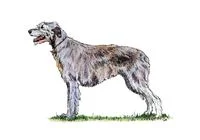

If you have fallen in love with the extraordinary size, quiet dignity and unmistakable appearance of the Irish Wolfhound but somebody in your household has allergies, there is one question you need answered before going any further:
Are Irish Wolfhounds hypoallergenic?
No. Irish Wolfhounds are not hypoallergenic.
They have a rough double coat, they shed throughout the year, and — like every dog — they produce proteins found in dander and saliva that can trigger allergic reactions in sensitive people.
But there is an important point hidden behind that simple answer.
Dog allergies are not really about how much hair you can see.
That misunderstanding leads many prospective owners to choose breeds based entirely on shedding, only to discover that living with the dog still causes sneezing, itching or other allergy symptoms.
So if you love Irish Wolfhounds for sale but suffer from dog allergies, don’t make your decision based on the word hypoallergenicalone.
You need to understand what actually causes the reaction.
Let’s separate the facts from the myths.
Are Irish Wolfhounds Hypoallergenic? The Short Answer
No.
Irish Wolfhounds are not considered a hypoallergenic dog breed.
They have a rough, hard coat with a softer undercoat and naturally lose hair throughout the year.
That shed hair can help carry dander and other allergenic material into the environment.
But even that doesn’t tell the entire story.
An Irish Wolfhound that somehow never dropped a single visible hair could still potentially trigger an allergic reaction.
Why?
Because dog hair itself isn’t usually the primary allergen.
What Actually Causes Dog Allergies?
This is where the word “hypoallergenic” causes a great deal of confusion.
Many people assume:
More dog hair = more allergies.
And therefore:
Less dog hair = no allergies.
Unfortunately, biology isn’t that convenient.
People with dog allergies generally react to proteins associated with a dog’s:
- dander
- saliva
- skin secretions
- urine
Dander consists of microscopic particles shed from the skin.
These particles are tiny.
Far smaller than the wiry Irish Wolfhound hairs you might notice on your jumper.
They can become airborne, settle on furniture, become embedded in carpets and bedding, and attach themselves to shed hair.
Saliva matters too.
A dog licks its coat.
Saliva dries on the hair and skin.
The dog moves around, scratches or sheds.
Allergenic material can then spread through the environment.
That is why simply looking at the amount of hair on the floor doesn’t tell you how somebody with allergies will react to a particular dog.
What Does “Hypoallergenic Dog” Actually Mean?
The term is frequently misunderstood.
There is no completely hypoallergenic dog.
Every dog produces biological material capable of causing allergic reactions in susceptible people.
When breeds are described as “hypoallergenic,” what people generally mean is that they may be less likely to spread allergens around the environment, often because they shed very little.
That is a very different claim from:
“This dog cannot cause allergies.”
No responsible breeder should be able to guarantee that a puppy will never trigger somebody’s dog allergy.
Individual reactions vary too much.
And that brings us back to the Irish Wolfhound.
Why Aren’t Irish Wolfhounds Hypoallergenic?
There are several reasons Irish Wolfhounds aren’t generally suitable for someone specifically seeking a low-allergen, low-shedding breed.
1. Irish Wolfhounds Shed
Irish Wolfhounds shed naturally throughout the year.
Their coat doesn’t simply remain attached indefinitely.
Old and dead hair comes away and is replaced as part of the normal coat cycle.
Every hair that ends up on the carpet, sofa, dog bed or your clothing can potentially carry material from the dog’s skin.
Regular grooming can control loose coat.
It cannot turn an Irish Wolfhound into a non-shedding dog.
2. They Produce Dander
All dogs produce dander.
Irish Wolfhounds are no exception.
And because dander contains proteins capable of triggering allergic reactions, the absence of enormous piles of visible fur doesn’t mean the absence of allergens.
This is one reason people can sometimes react strongly to a dog even when the home appears remarkably free from dog hair.
3. They Produce Saliva
Anyone who has lived with a large dog understands that saliva isn’t exactly a theoretical concept.
Irish Wolfhounds lick themselves.
They may lick people.
Their beard can become wet after drinking.
Saliva can remain on hair, skin, hands, clothing and household surfaces.
For somebody sensitive to dog allergens, this can matter.
4. They Are Enormous Dogs
This point is easy to overlook.
An Irish Wolfhound isn’t simply a normal-sized dog wearing a rough coat.
It is a giant hound.
More dog means more skin surface, more coat, a larger bed, more contact with furniture and considerably more physical presence inside the home.
Size alone does not determine how allergenic a dog will be.
But if your strategy for managing allergies depends on minimising contact and keeping the dog’s living area contained, doing so with an Irish Wolfhound presents obvious practical challenges.
You aren’t exactly going to overlook one in the corner.
Do Irish Wolfhounds Shed a Lot?
Irish Wolfhounds have a double coat consisting of a harsh, wiry outer coat and a softer undercoat.
They shed throughout the year.
However, their shedding isn’t necessarily comparable with the dramatic seasonal coat loss associated with some longer-coated breeds.
The important distinction for allergy sufferers is that:
They shed at all.
Shed hair can transport dander and other allergenic material around your home.
Regular brushing helps remove loose coat in a controlled way rather than allowing it to gradually distribute itself across carpets, furniture and clothing.
But grooming reduces loose hair.
It does not eliminate the allergens produced by the dog.
Does Their Wiry Coat Make Irish Wolfhounds Better for Allergies?
Not necessarily.
This is another common assumption.
People sometimes hear “wiry coat” and immediately associate it with terriers or other breeds commonly described as better options for allergy sufferers.
But coat texture alone doesn’t determine whether a breed is appropriate for somebody with allergies.
Irish Wolfhounds have a distinctive rough coat, but they also have an undercoat and shed.
So the fact that their outer coat feels coarse rather than fluffy should not be interpreted as evidence that they are hypoallergenic.
Wiry does not automatically mean allergy-friendly.
Can You Be Allergic to Some Dogs but Not Others?
Yes — and this is one of the most important things prospective owners should understand.
Dog allergies are highly individual.
One person may experience symptoms almost immediately around a particular dog.
Another may experience relatively mild symptoms.
Someone else may tolerate one individual dog better than another.
That variation is precisely why reading a breed description online can never tell you with certainty how your body will respond.
If you have known dog allergies and are seriously considering an Irish Wolfhound, your research shouldn’t end with Google.
The next stage should involve the actual breed.
Before Buying an Irish Wolfhound, Spend Time With Adult Wolfhounds
This may be the most useful advice in this entire article.
Do not discover the severity of your reaction after bringing an Irish Wolfhound puppy home.
If possible, spend meaningful time around adult Irish Wolfhounds first.
And “meaningful time” doesn’t mean standing next to one outdoors for five minutes.
Spend enough time in a realistic environment to understand how you respond.
If you are working with a responsible breeder, explain your allergy concerns openly.
Ask whether you can spend time around their adult hounds.
Handle them.
Sit near them.
Allow normal interaction.
Then pay attention to how you feel during and after the exposure.
This still cannot guarantee that you will react identically to every Irish Wolfhound, but it provides considerably more useful information than choosing a breed based solely on an online label.
What Are the Symptoms of a Dog Allergy?
Dog allergies can present differently from one person to another.
Possible symptoms can include:
- sneezing
- runny nose
- nasal congestion
- itchy nose
- itchy or watery eyes
- coughing
- skin irritation after contact
- worsening respiratory symptoms in susceptible individuals
The severity can range from relatively mild irritation to symptoms that make living with a dog impractical.
If you suspect you have a significant dog allergy, seek appropriate medical advice rather than attempting to diagnose the cause yourself.
You may be reacting to dogs.
You may also be reacting to something else in the environment.
Knowing the difference matters enormously before making a long-term commitment to a puppy.
Can You Live With an Irish Wolfhound If You Have Allergies?
Possibly.
But the answer depends much more on you than on the breed.
Some people with mild dog allergies may find that sensible household management allows them to live comfortably with a dog.
Others may experience symptoms severe enough that doing so would be unrealistic.
There is no responsible universal answer.
If you already know that contact with dogs causes substantial reactions, an Irish Wolfhound would not be the logical breed to choose specifically because you are looking for a hypoallergenic dog.
If your symptoms are mild and you tolerate individual Wolfhounds reasonably well, the situation may be different.
The crucial point is:
Test reality before making the commitment.
How to Reduce Dog Allergens in a Home With an Irish Wolfhound
If somebody in your household has mild allergies and you have decided — with appropriate medical guidance — to live with an Irish Wolfhound, reducing allergen accumulation becomes important.
You probably cannot create an allergen-free home.
You can, however, reduce how much hair, dander and biological material accumulates in certain areas.
1. Keep the Bedroom Dog-Free
If allergies are an issue, your bedroom is one of the most useful places to establish a firm boundary.
You spend roughly a third of your life sleeping.
Allowing allergens to accumulate on pillows, mattresses and bedding can create hours of continuous exposure.
Keeping your Wolfhound out of the bedroom gives you at least one area of the home with reduced direct exposure.
And yes, convincing an enormous, affectionate Wolfhound that the bedroom is forbidden may require consistency.
Establish the rule early.
2. Groom Your Irish Wolfhound Regularly
Regular grooming removes loose and dead hair before it spreads around the house.
A thorough weekly brushing is a sensible routine for many Irish Wolfhounds.
Work through the entire coat rather than simply brushing the dog’s back.
Pay attention to the:
- neck
- chest
- sides
- legs
- belly
- hindquarters
- tail
- beard
Where practical, grooming outdoors can help prevent loosened hair and debris from immediately entering the home.
Ideally, the person with the allergy shouldn’t be the one enthusiastically brushing clouds of loose material from a giant hound.
3. Wash Dog Bedding Regularly
Your dog’s bed is an obvious collection point for hair, skin particles, dirt and saliva.
Choose bedding with removable, washable covers whenever possible.
With an Irish Wolfhound, this requires some planning because “dog bed” can mean something approximately the size of a small island.
Wash covers regularly and vacuum around the sleeping area.
4. Vacuum Frequently
Loose hair is easy to see.
Dander isn’t.
Vacuuming carpets, rugs, upholstery and areas where your Wolfhound spends considerable time can help reduce accumulated material.
Pay particular attention to corners and edges.
Giant dogs have a remarkable ability to distribute hair into places they have apparently never visited.
5. Consider Hard Flooring
Carpet can trap hair, dander and other particles.
Hard flooring is generally easier to vacuum and wipe clean.
Nobody should renovate an entire house on the strength of one blog article, of course.
But if you already have allergy concerns and are planning a dog-friendly home, surfaces that are easy to clean have obvious practical advantages.
6. Clean the Beard
Never underestimate the Irish Wolfhound beard.
It is magnificent.
It is expressive.
And after the dog drinks, it can also become a mobile delivery system for water and saliva.
Wipe the beard when necessary and keep it clean.
The objective isn’t cosmetic perfection.
It is basic hygiene.
7. Wash Your Hands After Close Contact
If direct contact triggers symptoms, washing your hands after stroking or grooming the dog can help reduce transfer to your eyes, nose and face.
This is particularly important if you unconsciously touch your face frequently.
8. Improve Household Air Management
Airborne particles can contribute to exposure.
Good ventilation and appropriate air filtration may form part of a broader household allergy-management strategy.
But don’t fall into the trap of believing that buying one expensive air purifier somehow transforms an Irish Wolfhound into a hypoallergenic breed.
It doesn’t.
Household management is about reducing exposure, not eliminating the dog’s biology.
Does Bathing an Irish Wolfhound Make Them Hypoallergenic?
No.
Bathing can remove dirt and some material from the coat temporarily.
It does not permanently prevent the dog from producing dander, saliva or other allergens.
Over-bathing isn’t the solution either.
An Irish Wolfhound should be bathed when appropriate using products suitable for dogs, rather than constantly shampooed in an attempt to control human allergies.
Think of bathing as part of normal coat hygiene.
Not an allergy cure.
Will Shaving an Irish Wolfhound Help With Allergies?
This is a particularly important myth to correct.
Shaving the dog will not make an Irish Wolfhound hypoallergenic.
Remember:
The hair itself isn’t the fundamental problem.
Allergenic proteins are produced by the dog.
Removing the visible coat doesn’t remove the dog’s skin or saliva.
Nor does clipping prevent the natural biological production of allergens.
The Irish Wolfhound’s characteristic rough coat should be maintained appropriately rather than shaved simply because somebody believes shorter hair will solve an allergy problem.
What About Hand-Stripping?
Irish Wolfhound owners may encounter the term hand-stripping when researching coat care.
Hand-stripping involves removing mature dead hairs from a wire coat rather than simply cutting them shorter.
Performed correctly, it can help maintain the characteristic texture and condition of an Irish Wolfhound’s rough coat.
It may also help remove dead hair in a controlled grooming session rather than waiting for that hair to find its own way onto your furniture.
But once again:
Better coat management is not the same as hypoallergenic.
A beautifully groomed Irish Wolfhound still produces allergens.
Are Irish Wolfhound Puppies Hypoallergenic?
No.
An Irish Wolfhound puppy should not be considered hypoallergenic simply because its puppy coat may look or feel different from the eventual adult coat.
This distinction is especially important for prospective owners.
You might spend time with a young puppy and experience relatively little discomfort.
That doesn’t guarantee that your experience will remain identical as the puppy matures into an enormous adult with a fully developed coat.
Remember what you’re choosing.
That adorable puppy isn’t going to remain a small bundle curled up beside your feet.
It is going to become an Irish Wolfhound.
Make your decision based on the adult dog you will live with, not merely the puppy standing in front of you today.
Are Female Irish Wolfhounds More Hypoallergenic Than Males?
You should not choose a male or female Irish Wolfhound on the assumption that one sex will automatically solve your allergy problem.
Individual allergic responses can be complex.
If allergies are a major consideration, actual exposure and professional medical guidance are far more useful than relying on broad claims that one sex is “hypoallergenic.”
Choose the individual dog and breeder responsibly.
Don’t gamble on a simplistic allergy shortcut.
Irish Wolfhound vs Hypoallergenic Breeds
If your number-one requirement is finding a dog that sheds very little and is commonly considered more manageable for allergy sufferers, an Irish Wolfhound probably shouldn’t be near the top of your shortlist.
There are breeds more commonly considered for allergy-sensitive households because of their coat characteristics.
But remember the central lesson:
No dog comes with a zero-allergen guarantee.
Even breeds widely described as hypoallergenic can trigger reactions in some people.
That is why personal exposure matters more than marketing terminology.
The Question Prospective Owners Should Really Ask
“Are Irish Wolfhounds hypoallergenic?” is a useful starting question.
But it isn’t the best final question.
The better question is:
“Can the person in my household with allergies comfortably tolerate living with an Irish Wolfhound every day?”
Those are very different questions.
The first can be answered in a sentence:
No.
The second requires:
- honest assessment of allergy severity
- exposure to adult Irish Wolfhounds
- realistic expectations
- appropriate medical advice where necessary
- consideration of household cleaning
- willingness to groom regularly
- understanding of the breed’s enormous adult size
That second question is the one that should determine your decision.
Don’t Choose a Puppy Hoping the Allergy Will Improve
This deserves its own section because the consequences can be heartbreaking.
Bringing home an Irish Wolfhound puppy is a serious commitment.
If somebody in the family already has significant dog allergies, don’t buy a puppy based on the hope that:
“We’ll probably get used to it.”
Maybe symptoms will be manageable.
Maybe they won’t.
A puppy should not become an experiment.
Responsible ownership means investigating foreseeable problems before the dog becomes part of the family.
An Irish Wolfhound can form an extraordinarily strong presence in a household.
Having to rehome one because a known allergy became unbearable is a situation everyone would rather prevent.
Do the difficult thinking first.
Frequently Asked Questions About Irish Wolfhounds and Allergies
Are Irish Wolfhounds hypoallergenic?
No. Irish Wolfhounds are not hypoallergenic. They shed naturally and produce dander and saliva containing proteins that can trigger allergic reactions in sensitive people.
Do Irish Wolfhounds shed?
Yes. Irish Wolfhounds have a double coat and shed throughout the year. Regular brushing helps manage loose hair but does not eliminate shedding.
Do Irish Wolfhounds have dander?
Yes. Like other dogs, Irish Wolfhounds naturally shed microscopic skin particles commonly referred to as dander.
Can Irish Wolfhounds cause allergies?
Yes. A person with dog allergies may experience symptoms around an Irish Wolfhound. The severity varies considerably between individuals.
Can someone with mild allergies own an Irish Wolfhound?
Possibly. Some people with relatively mild allergies may tolerate an individual Irish Wolfhound better than others. Spend substantial time around adult Wolfhounds before committing and seek appropriate medical advice if allergies are a significant concern.
Does brushing an Irish Wolfhound reduce allergens?
Regular brushing can help control loose hair and debris and reduce how much shed material accumulates around the home. It cannot prevent the dog from producing allergens.
Will shaving an Irish Wolfhound make it hypoallergenic?
No. Shaving does not stop the dog from producing allergenic proteins and should not be used as a solution to dog allergies.
Are Irish Wolfhound puppies hypoallergenic?
No. Irish Wolfhound puppies should not be considered hypoallergenic. Their coat also changes as they mature, so tolerance of a young puppy does not guarantee identical tolerance of the adult dog.
Do Irish Wolfhounds shed more than hypoallergenic dogs?
Irish Wolfhounds shed throughout the year, whereas many breeds commonly described as hypoallergenic are characterised by low-shedding or non-shedding coats. However, shedding alone does not determine whether a particular dog will trigger an allergic reaction.
Can an air purifier make an Irish Wolfhound safe for allergy sufferers?
An appropriate air-cleaning strategy may help reduce airborne particles as part of wider allergy management, but no air purifier can guarantee that somebody allergic to dogs will tolerate an Irish Wolfhound.
Final Verdict: Are Irish Wolfhounds Hypoallergenic?
No — Irish Wolfhounds are not hypoallergenic.
They have a rough double coat.
They shed.
They produce dander.
They produce saliva.
And any of these biological materials can contribute to allergen exposure in sensitive people.
That doesn’t automatically mean every person with a mild dog allergy must rule out the breed.
Individual reactions vary.
But an Irish Wolfhound should never be chosen because somebody wants a hypoallergenic dog.
If allergies are part of your household, meet adult Irish Wolfhounds before committing. Spend meaningful time around them. Understand your reaction. Speak with a responsible breeder. And, where appropriate, discuss significant allergy concerns with a qualified healthcare professional.
Because choosing an Irish Wolfhound should be about whether you can provide the right home for this remarkable giant hound for its entire life.
Not whether you can tolerate one for twenty minutes.
Research first. Meet the breed. Understand the reality. Then make the decision that is right for both your family and the hound.
